
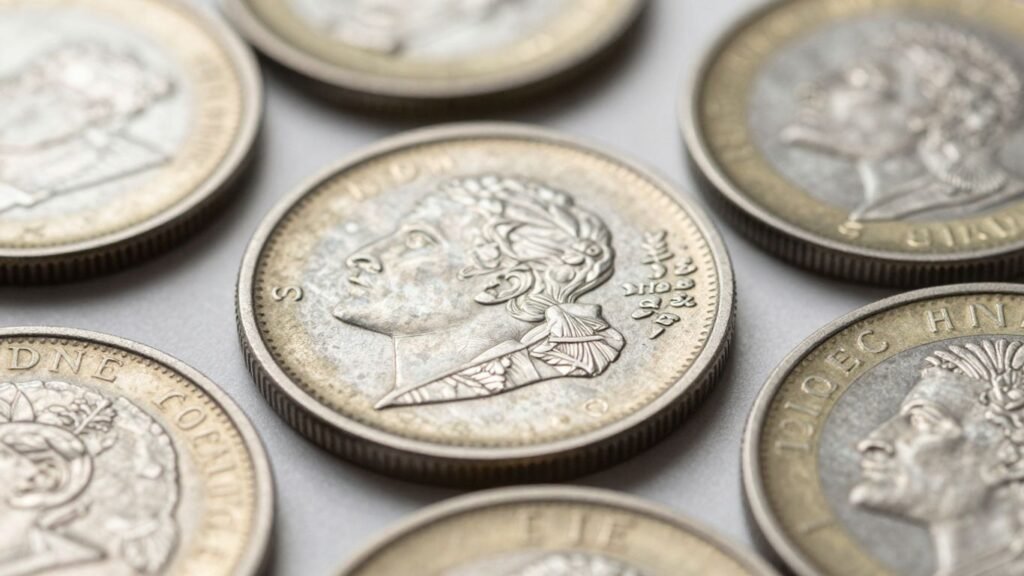
Ever looked at a coin and wondered about those lines on the edge? They’re not just for show, believe it or not. This coin edge variations guide is here to break down all those different patterns, why they exist, and how you can spot them. From the simple reeds we see every day to some really unusual errors, there’s a whole lot going on with coin edges. Let’s get into it.
Key Takeaways
- The collar in the minting process is what creates the reeding on a coin’s edge by pressing into the metal.
- Reeds, knurls, and flutes are specific terms describing the raised ridges and indentations on a coin’s edge.
- Historically, reeding was introduced to prevent people from shaving off metal from the coin’s edge.
- Counting the number of reeds can be a useful way to tell coins apart, especially when they look very similar.
- There are several methods, from simple visual checks to using clay impressions or magnification, for counting coin reeds accurately.
Understanding Coin Edge Variations
Ever looked closely at the edge of a coin? It’s not just a plain metal band; it’s a carefully crafted part of the coin’s design and security. The way the edge is finished, especially with those little lines we call reeds, tells us a lot about how the coin was made and even its history. These edge details are more than just decoration; they serve practical purposes and can even help identify specific coins or errors.
The Role of the Collar in Minting
The collar is a pretty important piece of equipment in the coin-making process. Think of it as a ring that holds the blank coin in place while the dies strike it. This ring has grooves cut into its inner surface. When the coin blank is hit with immense pressure, the metal not only gets impressed with the design from the dies but also flows outwards and fills these grooves in the collar. This is what creates the patterns on the edge, like the familiar reeding. The clearance between the collar and the dies is super tight, just a few thousandths of an inch. If this gap is too big, some metal can escape, leading to what’s called a "wire rim." The shape of these grooves, determined by the toolmaker, dictates the final look of the coin’s edge.
Defining Reeds, Knurls, and Flutes
Let’s clear up some terms. When we talk about the edge, we’re often referring to "reeding." A single "reed" is the raised ridge. The collective term for all these ridges is "reeding." Each individual ridge is technically called a "knurl," and the space between the knurls is a "flute." So, a reed is essentially one knurl plus one flute. These are formed by the collar during the striking process. The metal has to flow perfectly into the collar’s grooves to create these features. If there isn’t enough metal or the pressure isn’t right, the tops of the knurls might not form properly. Sometimes, just increasing the striking pressure can fix this.
The Striking Process and Metal Flow
During the striking process, the coin blank is placed in the collar. Then, the upper and lower dies come down with incredible force. The metal of the blank expands to fill every detail on the dies – the designs, the lettering, everything. At the same time, it’s pushed against the collar. If everything is just right – the right amount of metal in the blank and the correct striking pressure – the metal flows into the grooves of the collar, forming the reeding. After the strike, the coin is essentially stuck in place. It needs to be ejected, usually by one of the dies pushing it out of the collar. This ejection process is why certain edge treatments, like lettering or complex patterns, can’t be easily done with a fully reeded edge; the coin needs to slide out smoothly. This is also where concepts like interrupted reeding come in, allowing for smooth sections on an otherwise reeded edge, which can be useful for things like edge inscriptions or hallmarks. The Franklin Mint even used interrupted reeding to help casinos identify their own tokens, a clever use of coin security features.
The collar’s role is multifaceted. It not only shapes the coin’s edge but also ensures the coin maintains its proper diameter and thickness. The precision required in its manufacturing directly impacts the final appearance and integrity of the coin’s edge, making it a critical component in the minting machinery.
The Evolution of Reeded Edges
Historical Context of Edge Treatments
Before coins had those familiar ridges, their edges were often plain. This simplicity, however, created a problem. People could easily shave off tiny bits of metal from the edges of coins, a practice called clipping, and then melt down the shavings to make more money. It was a sneaky way to defraud people and devalue currency. Imagine a whole stack of coins, each slightly lighter than it should be. Over time, this added up to a significant loss for everyone.
Sir Isaac Newton's Influence on Coin Security
It turns out, even brilliant minds like Sir Isaac Newton were concerned with this issue. While he’s famous for physics and math, he also served as the Master of the Royal Mint in Britain. He was a big proponent of making coins harder to tamper with. The idea of reeding the edges was a clever solution to stop coin clipping. By adding those distinct ridges, any attempt to shave off metal would be obvious. It was a simple but effective security measure.
The First Reeded Edge Coin Query
Pinpointing the exact first coin ever made with a reeded edge is a bit of a numismatic mystery. We know that the collar, the tool that creates these ridges, was first used in the Paris Mint way back in 1555. But the very first coin to sport those reeded edges? That’s harder to say for sure. It likely appeared sometime in the late 1500s or early 1600s. It’s a question that still sparks discussion among coin collectors and historians today.
Exploring Different Reed Patterns
So, we’ve talked about how coins get those ridged edges, right? But not all ridges are created equal. When you start looking closer, you’ll see there are actually different ways these patterns can show up. It’s not just a simple "yes" or "no" to reeding; there’s a bit more to it.
Fully Reeded vs. Interrupted Reeding
Most coins you see have what we call "fully reeded" edges. This means the ridges, or reeds, go all the way around the coin’s circumference without any breaks. It’s the classic look, and it’s been around for ages. But then there’s "interrupted reeding." This is where you’ll find smooth sections mixed in with the reeds. Think of it like a pattern with gaps. Why would anyone do that? Well, it turns out there are some pretty neat reasons.
The Franklin Mint's Innovative Use of Interrupted Reeding
Back in 1965, the Franklin Mint had a bit of a problem. They were making a bunch of gambling tokens for casinos in Las Vegas, and people were mixing them up. Imagine trying to pay your casino chips and accidentally handing over a token from a different casino – not good! The solution? They used interrupted reeding. Each casino got tokens with a unique pattern of reeded and smooth sections. It was like a secret code on the edge of the coin, making it super easy to tell which token belonged where, even when they were stacked in rows. Joseph Segel even got a patent for this idea in 1967. Pretty clever, huh?
Reed Count as a Numismatic Diagnostic
Now, this is where things get interesting for coin collectors, or numismatists as they like to be called. The number of reeds on a coin’s edge isn’t always the same, even on coins that look identical otherwise. Sometimes, different mints or even different production runs can result in a slightly different reed count. This can be a really useful clue for figuring out if a coin is what it’s supposed to be. For example, a 1968 Canadian dime struck in Philadelphia might have a different reed count than one struck in Canada. It’s like a fingerprint for the coin’s edge!
Here’s a quick look at how reed counts can differ:
| Coin Type | Typical Reed Count | Notes |
|---|---|---|
| US Quarter | 118 | Can vary slightly |
| US Dime | 118 | Generally consistent |
| Canadian Loonie | 240 | Often has interrupted reeding sections |
| British Pound | 256 | Varies by specific coin |
The specific number of reeds on a coin’s edge is determined by the collar used during the minting process. The grooves cut into the collar directly translate to the reeds formed on the coin. Variations in the collar’s design or wear can lead to differences in reed count, making it a subtle but important detail for identification and authentication.
Identifying and Differentiating Coins by Reed Count
So, you’ve got a coin, and you’re looking at its edge. See those little lines? Those are reeds, and believe it or not, counting them can tell you a lot. It’s not just about knowing how many there are; it’s about how they’re spaced, if they’re complete, or if there are gaps. This stuff matters, especially when you’re trying to figure out if a coin is what it’s supposed to be.
Case Study: 1968 Canadian Dimes
Let’s talk about the 1968 Canadian dime. This is a classic example of why reed count is a big deal. Normally, Canada’s mint handles all their dime production. But in ’68, they needed help, so they outsourced some of the work to the Philadelphia Mint in the U.S. The coins look pretty much the same, right? But there’s a difference in the edge reeding. The Canadian-minted ones have a specific number of reeds, while the ones made in Philadelphia have a different count. This subtle difference in reed count is a key way numismatists tell these two groups of coins apart. It’s a neat bit of history and a practical lesson in coin identification.
The Significance of Reed Count in Authentication
Why go through the trouble of counting reeds? Well, it’s a diagnostic tool. Think of it like a fingerprint for coins. Mints have specific patterns and counts they use for different denominations and even for coins struck in different years or locations. If a coin shows up with the wrong number of reeds for its supposed origin, it’s a red flag. It could be a genuine error, a variation, or, unfortunately, a fake. For collectors and dealers, knowing these details helps avoid costly mistakes and ensures the authenticity of a piece. It’s a detail that’s hard to fake convincingly, especially on a large scale. You can find some really interesting historical coins, like a 1796 Capped Bust Right Quarter Eagle, that have unique edge treatments worth studying.
Variations in Reed Density Across Coinage
Reed density isn’t uniform across all coins. Different countries and different eras used varying numbers of reeds. Some coins might have very fine, closely spaced reeds, while others have coarser, more widely spaced ones. Even within the same country, a dime might have a different reed count than a quarter or a dollar coin. This variation is often tied to the size of the coin and the machinery used at the time. It’s also influenced by the metal flow during the striking process. The collar die, which forms the edge, dictates the final pattern. Sometimes, you’ll even find coins with interrupted reeding, meaning there are smooth sections interspersed with the reeds. This was often done to allow for edge lettering or other markings, a technique that became quite innovative, as seen with some early uses by the Franklin Mint.
Here’s a quick look at some common reed counts for U.S. denominations:
| Denomination | Typical Reed Count |
|---|---|
| Dime | 118 |
| Quarter | 118 |
| Half Dollar | 150 |
| Dollar | 192 |
Remember, these are typical counts. Errors or variations can occur, and different series or mints might have slight deviations. Always check reliable numismatic resources for specific coin series you’re interested in.
Counting reeds can seem tedious, but it’s a skill that pays off. It’s a tangible way to connect with the manufacturing process of coins and a solid method for authentication. It’s one of those details that, once you start noticing it, you see it everywhere.
Practical Applications of Reeded Edges
You know, it’s easy to just see those little lines on the edge of a coin and think, ‘Oh, that’s just how they make ’em.’ But those reeds, or reeding as it’s called, actually do a few pretty useful things. It’s not just for show, that’s for sure.
Aiding the Visually Impaired
One of the most important jobs reeding has is helping people who can’t see well. Think about it: a quarter has reeds, but a nickel, which is about the same size, has a smooth edge. This difference makes it way easier for someone who is blind or has low vision to tell them apart just by touch. It’s a simple design feature, but it makes a big difference in everyday life for many.
Enhancing Coin Handling and Grip
Ever tried to pick up a coin that’s slippery or wet? It’s a pain. The reeds give your fingers a bit of texture to grab onto. It might seem minor, but it makes coins easier to handle, less likely to slip out of your hand when you’re trying to grab them from a pocket or a counter. It just adds a little bit of friction that helps.
Benefits for Automated Sorting and Counting
Machines that sort and count coins, like the ones you see at the bank or in some businesses, also get a little help from reeding. The consistent pattern of ridges and grooves can be detected by sensors in these machines. This helps them identify and separate different denominations more accurately and quickly. It’s one less thing for the machine to guess about.
The simple act of adding ridges to a coin’s edge is a clever bit of engineering that serves multiple purposes, from accessibility for the visually impaired to improving the efficiency of coin-handling technology. It’s a testament to how thoughtful design can have far-reaching practical benefits.
Here’s a quick look at how reeding helps:
- Accessibility: Differentiates coins by touch for the visually impaired.
- Grip: Provides texture for easier handling and prevents slippage.
- Automation: Aids coin-sorting and counting machines with identification.
- Security: Historically, it was a way to deter clipping and shaving of coin edges.
Techniques for Counting Coin Reeds
So, you’ve got a coin and you’re curious about its edge. Maybe you’re trying to figure out if it’s a rare variety, or perhaps you’re just a detail-oriented collector. Whatever the reason, counting those little ridges, or reeds, can be a bit of a puzzle. It’s not always as straightforward as it looks, and different people have come up with some pretty clever ways to get the job done.
Visual Inspection and Photographic Methods
Sometimes, the simplest approach is to just look closely. Grab a magnifying glass, maybe even a jeweler’s loupe, and carefully examine the coin’s edge. The trick is to find a good starting point and a way to keep track so you don’t lose your place. It’s easy to get distracted and start counting all over again. Marking a specific reed with a soft pencil lead can help, as the graphite residue is usually easy to wipe off later without harming the coin. If you’re working with a photograph, especially an enlarged one, this becomes much easier. You can literally mark the reeds on the photo itself, perhaps marking every fifth or tenth one to make the final tally quicker.
Utilizing Modeling Clay for Impression
This method is pretty neat and uses common craft supplies. You’ll want some soft modeling clay – the kind you get at a hobby shop works great. Warm it up a bit by kneading it until it’s pliable. Then, flatten out a piece of the clay. Take your coin, mark one reed with a washable felt-tip marker, and then press the coin’s edge into the clay. Roll the coin along the clay, letting the reeds make an impression. The ink mark from your marker will show up on the clay each time that reed hits it. Keep rolling until you see the ink mark appear a second time. Now, you just count the indentations between the two ink marks. It’s a good way to get a clear, physical representation of the reeds, and you can even photograph the clay impression for your records. Plus, you can just ball up the clay and reuse it later.
Microscope-Assisted Reed Tallying
For those who want a bit more precision, a microscope can be a real game-changer. One popular technique involves using the reflector from an old flashlight. You place the coin in the reflector, put it under a stereo microscope, and then slowly rotate the coin. Viewing the edge through the scope, you can count the reeds. It’s best to start at a noticeable imperfection on the coin’s edge, like a small nick or a die crack, and count from there. Using the microscope’s reticle (the grid lines) can help you keep your place. Counting out loud can also help prevent errors. Some folks even paint every 20th reed with a bit of correction fluid (like White-Out) to create easy stopping points, which can be cleaned off later. This method, with a bit of practice, can make counting quite accurate and relatively quick, often taking just a couple of minutes.
Advanced Reed Counting Tools and Methods
DIY Reed Counting Aids
So, you’ve got a coin and you’re trying to figure out exactly how many reeds are on its edge. It sounds simple, right? Well, sometimes it’s trickier than it looks. While there are fancy tools out there, you can actually make some pretty useful gadgets yourself with stuff you might already have lying around. It’s all about getting a clear view and a way to keep track without losing your place.
One neat trick involves using modeling clay. Grab a bit of that soft, pliable stuff – the kind you get for crafts or school projects. Warm it up in your hands until it’s nice and soft. Then, flatten it out a bit, maybe a few inches long and about an inch wide. Now, take your coin and mark one of the reeds with a felt-tip marker. Gently press the edge of the coin into the clay and then roll it along the surface. The reeds will leave an impression. Keep rolling until you see that marker line show up again. You can then count the little indentations between the two marker lines. It’s a good way to get a clear imprint, and you can even use a magnifying glass to help with the count. Plus, you can just ball up the clay and reuse it later.
The Flashlight Reflector Technique
This method is pretty clever and uses something most people have: a flashlight. You’ll want to take apart a regular flashlight and carefully remove the shiny, parabolic reflector from inside. This reflector is designed to focus light, and it turns out it’s also great for focusing your view on a coin’s edge. Place the coin inside the reflector. The curved surface of the reflector helps to display the entire edge of the coin in a way that makes counting the reeds much easier. You can then use a magnifying glass or even a microscope to get a close-up look. If you have a digital camera, you can position it to take a picture of the coin within the reflector. This allows you to zoom in on the image later on your computer, making it much simpler to count each individual reed without having to hold the coin steady for ages.
Digital Photography and Image Magnification
In today’s world, digital cameras are a game-changer for coin enthusiasts. Forget trying to count reeds by eye on a tiny coin edge. With a decent digital camera, you can take high-resolution photos of the coin’s edge. The real magic happens when you transfer these photos to your computer. You can then use image editing software to zoom in, sometimes to an incredible degree. This magnification lets you see each reed clearly, almost like you’re looking through a powerful microscope. You can even mark reeds directly on the digital image to keep track of your count, preventing you from losing your place. It’s a clean, non-contact method that preserves the coin and provides a permanent record of your findings.
Counting coin reeds might seem like a tedious task, but with the right approach and tools, it becomes a manageable and even interesting part of coin collecting. Whether you’re using simple household items or modern digital technology, the goal is always the same: accuracy and ease of identification.
Common Coin Edge Error Types
Sometimes, things just don’t go perfectly at the mint. We’ve talked a lot about the fancy reeding and how it’s supposed to look, but what happens when it all goes wrong? Well, you get some pretty interesting errors that collectors actually love to find. It’s not just about the design on the front and back; the edge tells its own story, especially when it’s a bit messed up.
Broadstrike Errors and Smooth Edges
Imagine a coin that looks like it got a little too excited and spread out. That’s kind of what a broadstrike error is. These happen when the coin isn’t properly contained by the collar during striking. The metal has nowhere to go but outwards, making the coin a bit larger than usual and, importantly for us, giving it a smooth edge instead of the expected reeds. It’s like the coin forgot its manners and didn’t get pushed into its proper shape. You can still see the design, but it’s flatter, more spread out, and definitely missing that familiar edge texture. These can be quite affordable for error collectors, which is nice.
The Impact of Worn or Damaged Dies
Dies are the workhorses of coin production, and like any workhorse, they can get tired or injured. When dies get worn down or damaged over time, they don’t strike the planchets (the blank metal discs) as cleanly. This can lead to all sorts of issues, including weak reeding or even missing reeds in certain spots. Sometimes, a damaged die might not properly engage with the collar, leading to those smooth edge errors we just talked about. It’s a reminder that even the most precise machinery can have off days. You might see a coin with an edge that looks a bit fuzzy or incomplete, and that’s often the culprit.
Understanding Transitional Errors
This is where things get really interesting, especially for certain historical periods. Transitional errors happen when a coin is struck on a planchet that’s from a different composition than what was standard at the time. For example, in 1965, the U.S. switched dimes from silver to a copper-nickel clad composition. If a silver planchet somehow made its way into the production line after the switch, you’d get a dime struck on silver. These are super rare and valuable. The edge might look a bit different, or the overall color might be off. It’s a direct link to a specific moment in coin history when the mint was changing its materials. These errors are a tangible piece of that transition, making them highly sought after by collectors who appreciate the story behind the mistake. You might also find errors related to missing clad layers, where the copper core is exposed, giving the coin a distinctive two-tone look. These are also quite collectible and show how complex the minting process can be.
The Future of Coin Edge Variations

So, what’s next for coin edges? It’s a bit of a mixed bag, really. On one hand, we’ve got this push towards digital everything. Think about how we track things now – it’s all about data. Numismatists are starting to document coin details, including edge treatments, in digital databases. This makes it easier to share information and spot patterns, kind of like how people are trying to predict cryptocurrency prices using advanced models. It’s a big shift from just looking at physical coins.
But here’s the thing: physical coins aren’t going anywhere, and neither are their edges. Even with all the digital tools, the actual coin still matters. The feel of it, the specific details – those are things you can’t quite replicate on a screen. Plus, new coin designs are always popping up, and they might play with edge treatments in ways we haven’t seen before. It keeps things interesting for collectors and researchers alike.
Here are a few things we might see more of:
- More complex edge patterns: Beyond simple reeding, expect to see intricate designs or combinations of smooth and textured areas. This could be for security, aesthetics, or even to make coins easier to handle.
- Integration with smart technology: Imagine coins with embedded micro-markers or unique edge profiles that can be read by special scanners. This could be a new layer of security or a way to authenticate coins.
- Focus on sustainability: As mints look for ways to be more eco-friendly, we might see new materials or manufacturing processes that affect edge treatments.
The way we record and study coins is changing fast. While digital records are becoming more common, the physical coin itself, with all its unique characteristics like the edge, remains the primary object of study and collection. It’s a balance between the old and the new.
It’s also worth noting that edge errors, like those broadstrikes we talked about, will likely continue to be a point of interest. They’re a reminder that even with advanced technology, mistakes happen, and these mistakes can create rare and sought-after varieties. So, while the future might bring more sophisticated designs and digital tracking, the humble coin edge will probably still hold some surprises. It’s a fascinating area that keeps evolving.
Wrapping It Up
So, we’ve gone through all sorts of coin edges, from the simple smooth ones to those with fancy reeding and even interrupted patterns. It turns out there’s a lot more to a coin’s edge than just, well, the edge. It’s all about how they’re made, why they’re made that way, and how we can even use things like reed counts to tell coins apart. Whether you’re a seasoned collector or just starting out, paying attention to these details can really change how you look at your coins. It’s pretty neat how something so small can tell such a big story about minting history and even security. Keep an eye on those edges; you never know what you might discover.
Frequently Asked Questions
What exactly is reeding on a coin?
Reeding refers to the tiny, parallel lines or grooves you see on the edge of many coins. Think of them like little ridges and dips running all the way around. These aren’t just for looks; they have a practical purpose in how coins are made and used.
Why do coins have reeded edges instead of smooth ones?
The main reason for reeding goes back to history. It was invented to stop people from shaving off tiny bits of metal from the coin’s edge to melt down and make more money. The reeding made it obvious if someone had tampered with the coin’s edge.
How are these reeds actually made on a coin?
When a coin is being made, it’s pressed between two powerful dies. The edge of the coin is surrounded by a metal ring called a collar. This collar has grooves cut into its inside surface, and when the coin is struck with immense force, the metal of the coin is pushed outwards into these grooves, creating the reeding.
Are there different types of reeding?
Yes, there are! Most coins have ‘fully reeded’ edges, meaning the lines go all the way around. But sometimes, you’ll find ‘interrupted reeding,’ where there are smooth sections mixed in with the reeded parts. This was sometimes used to add lettering or special marks to the edge.
What is 'reed count,' and why is it important?
Reed count is simply the number of ridges (or reeds) you can count on a coin’s edge. This number can be a really useful clue for coin collectors and experts. Sometimes, coins that look identical might have been made at different mints or with slightly different tools, and the reed count is the only way to tell them apart.
How can I count the reeds on a coin myself?
It can be tricky! One way is to use a magnifying glass and carefully count each ridge. Another popular method involves using modeling clay: you roll the coin’s edge into the clay, leaving an impression, and then count the lines in the clay. Some people also use photos or even specialized tools.
Can reeding cause errors on coins?
Sometimes. If the coining press isn’t set up quite right, or if the metal blank isn’t the right size, the metal might not flow perfectly into the collar’s grooves. This can lead to errors where the reeding looks incomplete or even missing, sometimes resulting in a coin with a smooth edge, known as a broadstrike error.
Do reeded edges help people in other ways besides preventing tampering?
Absolutely! The texture of reeded edges makes coins easier for everyone to grip and handle, especially when picking them up. For people who are visually impaired, the difference between a smooth edge (like on a nickel) and a reeded edge (like on a quarter) can be a helpful way to identify different coins by touch.